
Hospital waste spans far beyond clinical bins, encompassing hazardous and non-hazardous medical waste, and massive quantities of non-medical waste. While each stream presents unique regulatory and logistical challenges, they also hold the potential for innovative circular approaches. Understanding this complex landscape is the first step toward building a more sustainable, resilient healthcare system that aligns with the principle of "first, do no harm."
A 2024 sustainability report by NZHI, developed for a 700-bed Belgian hospital group, revealed over 1,400 tons of waste generated in a single year, the equivalent of 720 tonnes of CO2. While total waste volumes have modestly increased since 2020 due to higher patient activity, the data delivered a powerful insight: waste per patient admission has decreased, and the recyclability of waste streams has improved. This demonstrates that efficiency and sustainability go hand in hand. Furthermore, this example exposes the often-hidden environmental footprint of hospitals while highlighting the system level changes possible when we start measuring, managing, and redesigning waste practices.
What happens to hospital waste today?
Hospitals generate a diverse and complex mix of waste that reflects the multi-faceted nature of modern healthcare. The European Waste Framework Directive sets the legal foundation for safe and environmentally sound waste treatment, mandating that healthcare waste is managed to protect both public health and the environment. In Belgium, waste policy is a regional matter, resulting in three different policy regimes: for Wallonia, Brussels, and Flanders. In Flanders, the legal framework is established by the Materials Decree (Materialendecreet) and its implementing regulation, Vlarema. Under this legislation, medical waste is classified as a "special waste substance", subject to strict rules on storage, transport, and disposal. Furthermore, hospital waste management extends beyond clinical streams; it also requires the rigorous sorting and management of all other waste streams generated within the facility to ensure full regulatory compliance.
1. Hazardous Medical Waste
Hazardous medical waste (HMW) includes materials that pose risks of infection, toxicity, or injury, such as contaminated lab waste, sharps, and blood. Storage and transport are tightly regulated, and disposal typically requires specialized high-temperature incineration at a price of more than €1.000 per tonne.

Figure 1: Empty HMW (grey and yellow) and radio-active waste (blue) barrels stacked at Veolia's Luithagen site in Antwerp, Belgium
Technological advancements are increasingly bridging the gap between HMW and NHMW waste streams. Decontamination systems, such as those developed by ECODAS or ECOSTERYL, are designed to transform HMW into a reclassified NHMW stream by using saturated steam or microwaves to sterilize the material before shredding.
However, the application of this technology is strictly governed by regional legislation. Under Vlarem and Vlarema regulations in Flanders, autoclaving is (currently) the only legally permitted decontamination technique. Furthermore, Vlarema imposes rigorous operational conditions to ensure total sterilization and provides an exhaustive list of specific HMW categories eligible for this process. Meaning that certain materials remain ineligible and must still be sent for specialized high-temperature incineration.
Beyond regulatory compliance, the business case for on-site decontamination requires a nuanced evaluation. While the transition offers significant savings in disposal costs, these benefits must be weighed against the substantial initial investment required for the equipment. Moreover, successful implementation demands a complex dual logistical flow within the hospital; staff must maintain a clear separation and manage specialized internal transport routes to distinguish between decontaminable and non-decontaminable waste streams at the source.
2. Non-hazardous Medical Waste
Non-Hazardous Medical Waste (NHMW) comprises materials generated during medical treatments that pose no specific biological, chemical, or physical risk, such as uncontaminated gowns, gloves, and surgical drapes. While hospitals are required to collect this stream separately from general waste, the regulatory requirements for its storage and transport are less stringent than those for HMW.
Currently in Flanders, this waste stream is processed in regular, NHMW-licensed municipal waste(to-energy) incinerators. Managing NHMW typically costs around €250 per tonne. The NHMW represents a major opportunity for increased circularity; once correctly sorted, these materials could become eligible for recycling, provided hygiene protocols are strictly met. To facilitate this transition in Flanders, OVAM is currently drafting an amendment to the VLAREMA regulations to enable the recycling of this waste streams.
3. Radio-active waste
Radioactive medical waste, resulting from nuclear medicine treatments or diagnostics, requires specialized handling. It must be stored in shielded containers until its radioactivity decays below safety thresholds. Once declassified by a certified radiation physicist, it can be processed as regular medical waste, provided biosafety and ADR (Agreement concerning Carriage of Dangerous Goods by Road) transport conditions are met.
4. Non-medical, general waste streams
Beyond medical-specific streams, hospitals generate large volumes of non-medical waste, such as food waste, paper, cardboard and chemicals. Remarkably, when properly sorted, streams like paper, cardboard and organic waste are almost free to process. In addition, it is important to note that in Flanders, sorting these specific waste streams at the source is not just a best practice, but a strict legal requirement. While these streams are theoretically easier to recycle than NHMW, their successful circularity depends on correct sorting at the source, proper infrastructure, and targeted staff training.

Figure 2 : Overview of different waste streams at Maria Middelares (2020–2024).
Pain points and system bottlenecks
Despite growing attention to sustainability, many hospitals still face major barriers in managing waste effectively and advancing circularity. These challenges are often operational and systemic, ranging from logistical hurdles to regulatory constraints. Crucially, the strategic goal must shift from simply "recycling better" to "wasting less" altogether.
According to the R-ladder framework, the gold standard for circular economy thinking, the highest priorities are Refuse, Rethink, and Reduce, followed by Reuse, Repair, and only then Recycling or energy recovery. Yet, hospitals continue to face significant blind spots at the top of the ladder, especially in refusing waste at the source. Instead of re-evaluating what enters the supply chain, many institutions passively accept standardized packaging and single-use disposables without considering tailored alternatives that better match clinical needs.
When it comes to recycling, correct sorting is essential but often fails in everyday practice. In many hospitals, non-clinical spaces such as staff kitchens and waiting areas lack appropriate bin separation and there is a general lack of awareness regarding the costs of improper recycling practices. As a result, recyclable materials like cardboard or PMD (plastic, metal, and drink cartons) are incorrectly thrown into NHMW bins, where they are unnecessarily incinerated. In clinical zones, effective separation depends heavily on staff attention and time. Sorting is currently a manual process that adds to the burden in high-pressure clinical environments. This challenge is particularly evident in operating rooms, where expecting staff to sort complex packaging into multiple waste streams during a procedure is often not realistic.
HMW management suffers from significant financial leakage. One of the most persistent issues is over-classification: non-hazardous items are frequently discarded in expensive HMW containers due to unclear guidelines, uncertainty, or time pressure. Recent waste audits performed by NZHI revealed that this misclassification often ranges between 15% and 50%. Since HMW costs four times the cost of NHMW, this lack of precision results in significant volumes of waste being sent for high-temperature incineration unnecessarily, leading to inflated disposal bills.
In some hospitals, dedicated recycling pickups are required for specific brands or items, such as pipette holders or staplers. These are collected separately by medtech firms, often requiring fragmented transport trips. While these efforts reflect supplier commitment to sustainability, exploring bundled, brand-agnostic approaches would unlock greater efficiency. A more circular approach involves grouping these items into broader recycling streams and coordinating consolidated pickups to reduce logistical strain and environmental impact. Ultimately, however, recycling is not the solution; therefore, the ecodesign of products is important to minimize waste complexity at the source.
We welcome the various initiatives from producers and healthcare institutions and we aim to help facilitate these projects by making recycling possible. On the other hand, the healthcare sector continues to rely heavily on 'single-use'. A behavioral change is needed to make the transition to 'reuse'.

Tackling hospital waste
Tackling hospital waste effectively requires a fundamental mindset shift: moving from downstream management to upstream prevention. While proper sorting remains a critical baseline, the most significant environmental and financial gains are found by redesigning products, processes, and procurement strategies before waste is ever created. To achieve true circularity and operational resilience, hospitals must move beyond basic waste management and embrace the Lansink's Ladder as a structured hierarchy of resource stewardship.
The journey begins at the highest tier with Prevention, ensuring waste is never created in the first place. A key strategy to prevention involves only procuring what is really needed and eliminating over-packaging. The Aarhus University Aarhus University Hospital in Denmark for example reassessed standardized surgical sets to match actual clinical needs. By embedding these considerations into clinical workflows and adopting just-in-time logistics to minimize overstock, hospitals can pre-empt waste while driving down costs. However, the path to prevention faces some hurdles. While the new EU Packaging and Packaging Waste Regulation (PPWR) sets ambitious reduction targets across most industries, medical packaging has been largely excluded from these strict requirements at the explicit request of manufacturers. This puts responsibility on hospital procurement teams to voluntarily push for sustainable alternatives.
When a product is clinically necessary, the focus shifts to Reuse, where durable alternatives replace a "throwaway" culture. The NHS in the UK provides a compelling blueprint for this level, where one Trust reported that replacing single-use laparoscopic instruments with reusable alternatives slashed carbon emissions by over 50% per operation and saved approximately £250 (≈€290) per set. Successful models like the Royal Brisbane and Women’s Hospital further prove that investing in reverse logistics for returning goods like mobility aids can unlock significant circular benefits and financial savings.
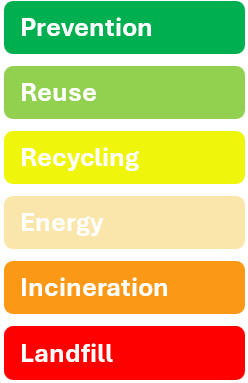
Figure 3: Lansink's waste hierarchy
For materials that cannot be maintained in their current form, the focus moves to Recycle, where success depends on empowering frontline staff with simple, visual interventions like color-coded bins and peer-led coaching. Hospitals in the Netherlands and Sweden have shown that providing clear systems and real-time feedback significantly enhances sorting accuracy, which directly reduces contamination and lowers volumes sent to the bottom of the ladder.
When materials cannot be recycled, the focus shifts to Energy recovery, ensuring waste serves as a fuel source rather than being merely destroyed. Notably, all waste incinerators in Flanders operate with this capability. Following energy recovery on the hierarchy is Incineration without energy recovery or high-temperature destruction of specialized hazardous materials. Although this remains a clinical necessity for certain risk categories, it is an inefficient end-of-pipe solution that represents a significant loss of the raw materials and the high carbon investment that went into manufacturing. Finally, at the absolute bottom of the ladder sits Landfill, representing permanent abandonment of resources. In Flanders, medical waste is never landfilled. Only specific non-combustible materials (e.g. asbestos) are permitted for landfill disposal.
By systematically climbing the ladder toward prevention and reuse, hospitals can move away from these final stages toward a model that truly preserves value and protects the environment that sustains our patients.
The role of procurement teams and suppliers
To climb the Lansink ladder as high as possible, the role of hospital procurement teams is essential. Preventing waste requires a fundamental rethinking of the tender process. Hospitals must move away from an excessive focus on the lowest upfront purchase price, often overlooking long-term disposal costs and instead weigh waste reduction and Total Cost of Ownership more heavily. Without this shift in financial perspective, sustainable innovation will remain sidelined by the hidden costs of cheap, high-waste products.
Strategic procurement must also protect the clinical frontline teams by shifting the logistical burden of waste management away from the ward. Because it is often unrealistic for busy healthcare staff to sort complex packaging under pressure, hospitals should require suppliers to "split" waste flows before they reach the hospital floor. Providing simplified or pre-sorted packaging ensures high recycling rates without adding extra tasks for teams focused on patient care. Achieving this level of operational ease depends on strategic partnerships where hospitals leverage their purchasing power to demand smarter solutions. Evidence confirms that embedding clear environmental standards into tenders, such as requiring vendors to pre-sort materials or collect empty containers, elevates the performance of the entire supply chain. By addressing waste at this level, hospitals and suppliers work together to eliminate inefficiencies and reduce transport emissions right at the source.
Tracking progress and driving change
To meaningfully reduce hospital waste, rigorous measurements must come first. Understanding the current waste landscape is the essential prerequisite for setting realistic, ambitious goals. By consistently tracking volumes, waste types, and recyclability, hospitals can pinpoint exactly where interventions are most needed. Once this baseline is established, actionable Key Performance Indicators (KPIs) can guide progress. For example, UMC Utrecht’s target of 75% recyclability by 2030 offers a clear industry benchmark. In Flanders, setting such goals aligns with OVAM’s push to improve NHMW sorting and supports transparent progress tracking. NZHI’s 2024 analysis of a Belgian hospital group showed that recyclability rose from 30% in 2020 to 38% in 2024.
Veolia strives for ambitious climate targets: a 50% reduction in Scope 1 & 2 emissions by 2032, a 30% reduction in Scope 3 emissions by 2032, and Net Zero by 2050. As a waste partner, our emissions have a direct impact on the Scope 3 footprint of companies. Therefore, we are actively making our processes more sustainable: from transport optimization and alternative fuels to circular innovations and renewable energy.
Veolia supports hospitals in their sustainability reporting with transparent CO2 data regarding waste streams. We calculate emissions from collection and processing based on validated, market-specific emission factors. The carbon report covers 26 waste streams, including tonnage, CO2 emissions per stream, treatment method, and transport kilometers striving for maximum transparency. By providing customers with reliable data and advice, Veolia helps organizations lower their carbon footprint and contribute to a circular economy.
But data alone does not change behavior. Impact happens on the floor, where waste sorting decisions are made in the heat of clinical workflows. That’s why NZHI recommends developing waste guides for each department, helping staff sort correctly within the high-pressure realities of their work. When coupled with quarterly feedback loops and tied to "Green Team" activities, these guides turn sorting into a shared, team-owned mission. Targeted training and clear, visual signage make compliance tangible, engaging, and second nature.
Sustainability must also be woven into the fabric of hospital governance. Green Teams play a vital role but cannot succeed in isolation. Procurement departments must include recyclability and waste reduction criteria in tenders, using these as key differentiators between vendors. Facilities teams must optimize internal logistics, from strategic bin placement to just-in-time waste flows. Crucially, medical departments must act as co-designers of these solutions to ensure they are clinically workable and context specific.
Finally, small changes can spark a massive cultural shift. Practical, low-barrier actions include adding paper and cardboard bins to waiting areas, improving sorting infrastructure in staff kitchens, digitizing paper flows, and aligning waste reporting with food waste reduction efforts. These interventions normalize sustainability practices and reinforce a culture where circular thinking becomes a core part of the mission.
Toward a circular hospital
Hospital waste is a mirror of how we organize care, purchase supplies, and embed sustainability into daily practice. As this blog demonstrates, impactful changes occur when hospitals shift their focus upstream: rethinking procurement, redesigning logistics, empowering staff, and demanding accountability from suppliers. Measurement and governance frameworks are the essential "vital signs" to guide these efforts, but the real drivers of circularity are cultural, structural, and strategic. Hospitals that lead on this front build long-term resilience and credibility in an increasingly climate-conscious healthcare landscape.
To bridge the gap between high-level policy and the daily reality of the hospital ward, these three high-impact steps are great starting points.
- Eliminate upstream waste by auditing procurement contracts for redundancies while mandating suppliers to provide pre-sorted packaging and return logistics.
- Provide visual sorting manuals in every department to enable accurate disposal decisions to improve recycling rates and slash costly hazardous waste misclassification.
- Institutionalize data-driven governance by tracking waste volumes and establishing clear, measurable recyclability KPIs across all hospital operations.
At NZHI, we support hospitals in transitioning from a "take-make-waste" model to durable, circular operations. Whether it is rethinking procurement workflows, implementing reverse logistics, rolling out smarter bin systems, or integrating waste data into reporting, NZHI offers the evidence-based tools, tailored strategies, and hands-on support to make circular healthcare a reality. Let us help you move from intent to impact.
We thank Astrid De Man (OVAM) and Vicky Daeninck (Veolia) for their expert review and valuable contribution to this article.